How Will Your Limited Company Budget for 2027 and Hit Its Goals?

Published 19 September 2026
A budget is not just a spreadsheet you update once and forget. For a limited company, it is one of the clearest ways to decide what the business can afford, where growth should come from, and when a good idea is too risky for the cash available.
With just over three months left of 2026, now is a practical time to build your 2027 budget. You still have enough time to review this year’s numbers, check what worked, notice where money leaked out, and set targets that are ambitious without being vague.
A strong budget should help answer simple but serious questions:
Can the company cover its regular costs?
How much cash should stay in reserve?
Which goals are worth funding?
What will happen if sales are slower than expected?
When can the company hire, buy stock, or invest in new tools?
This article is for general information only and should not be treated as financial, tax, or legal advice. For decisions about tax, salaries, dividends, VAT, or company structure, speak to a qualified adviser.

What do you want your 2027 budget to achieve?
Before listing every cost, start with the purpose of the budget. A useful budget needs a clear direction. Otherwise, it becomes a record of spending rather than a tool for making decisions.
For 2027, your goals might include:
Growing revenue
Building cash reserves
Hiring staff
Launching a new service or product
Reducing debt
Improving profit margins
Preparing for quieter months
The goal should be specific enough to measure. “Grow the company” is too broad. “Increase revenue by 15% while keeping gross margin above last year’s level” gives you something clearer to track.
This is where planning becomes practical. A limited company budget should link each major goal to the money, time, and risk involved.
How will the company grow?
If growth is the main aim, ask where it will come from.
Will sales increase because of:
More repeat customers
New sales channels
Higher prices
A wider product range
Seasonal demand
Larger contracts
More local visibility
More capacity from staff or equipment
For example, if the goal is to double busy-season sales, the budget must include the knock-on costs. More sales often need more money before the extra income arrives.
That might mean:
Stock bought upfront
Extra packaging or delivery costs
Temporary storage
A second pop-up location
More card processing fees
Extra staff hours
Higher software costs
More spend to create demand
A growth target without these costs can make the business look healthier than it is. The company may sell more, but still run short of cash if it has to pay suppliers weeks before customers pay.
How much cash should the company hold back?
Cash reserves protect the company from timing problems. A profitable business can still struggle if money comes in after bills are due.
Start by working out the monthly cost of keeping the company running. Include the costs that continue even when sales slow down, such as software, insurance, accountancy fees, loan repayments, wages, and rent if you have premises.
Then decide how many months of outgoings the company should hold. There is no single right answer, but the buffer should match the level of risk in the business.
A company with predictable monthly income may need a smaller reserve than one that relies on seasonal sales, large one-off projects, or stock bought far in advance.
Also think about short-term cash gaps. If you need to pay for stock, materials, or ads before revenue arrives, the reserve needs to cover that waiting period.
What will a new hire really cost?
Hiring can help the business grow, but the full cost is more than salary.
A realistic hiring budget should include:
Gross salary
Employer National Insurance
Pension contributions
Recruitment costs
Training and onboarding time
Equipment or software
Payroll administration
Any expected drop in productivity while the person learns the role
Then look at the payoff. When will the hire start to add value?
If the probation period is three months, you might model the cost from day one but delay the expected sales boost until month four. That gives a more honest picture of cash flow.
For example, a sales hire may not bring in meaningful revenue straight away. They need time to learn the product, speak to prospects, follow up, and close work. A budget that expects results in month one may create pressure that the numbers cannot support.
Which expenses does the company need to list first?
One of the first steps in building the 2027 budget is to gather a full list of company expenses. Use bank statements, accounting software, receipts, supplier invoices, payroll records, and card statements from 2026.
Do not rely on memory. Small subscriptions, irregular renewals, and card payments can quietly add up.
Once the list is complete, divide costs into three groups.
Which costs are fixed?
Fixed costs are regular costs that stay broadly the same each month or recur at set points during the year.
Examples include:
Accountancy fees
Insurance
Software subscriptions
Telephone and internet
Rent or storage
Loan repayments
Website hosting
Professional memberships
Regular payroll costs
Fixed costs are useful because they show the company’s baseline. If no new sales come in, these bills still need paying.
That gives you a starting point for the minimum income the company needs each month.
Which costs are variable?
Variable costs rise and fall with sales or activity.
Examples include:
Materials
Stock
Packaging
Delivery
Payment processing fees
Contractor support
Utilities linked to production
Sales commission
Travel linked to client work
Variable costs matter because they affect profit margins. If revenue grows but variable costs rise faster, the company may be busier without being better off.
For 2027, check whether suppliers are likely to increase prices. If core costs rose during 2026, use the newer prices in the budget rather than an old average.
Which costs are one-off?
One-off costs are less regular, but they can still have a big effect on cash.
Examples include:
A new laptop
Equipment repairs
Website rebuilds
Legal advice
Rebranding work
Trade show fees
Training
Deposits
New furniture for a shop or studio
A vehicle purchase or lease setup
One-off costs are easy to miss because they are not part of the monthly rhythm. Add them to the month when the payment is likely to happen. If the timing is uncertain, build in a cautious estimate.
How will tax and statutory costs affect cash flow?
A limited company budget should include taxes and statutory payments at the right time, not just the right amount.
Depending on the business, the budget may need to allow for:
Corporation Tax
VAT payments, if registered
PAYE and National Insurance
Pension contributions
Dividend planning, where relevant
Companies House filing fees
Accountancy and bookkeeping support
Corporation Tax often relates to profits from an earlier accounting period, so the payment timing can catch companies out. VAT can also create pressure if the company spends VAT collected from customers before the payment date.
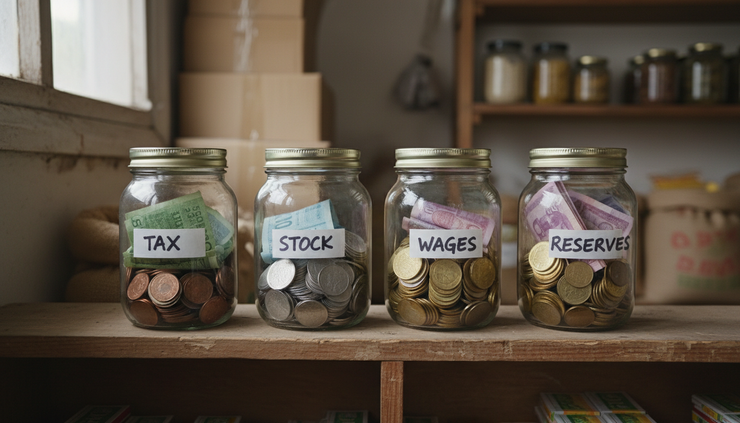
A simple approach is to move estimated tax money into a separate savings account regularly. That does not change the tax due, but it can reduce the risk of treating tax money as spare cash.
If the company pays directors through a mix of salary and dividends, build those drawings into the budget carefully. Dividends can only be paid from available profits, so they should not be treated as a guaranteed monthly cost in the same way as salary.
What income can the company realistically expect?
Revenue forecasts are where many budgets become too optimistic. A good forecast should be ambitious, but it should still reflect the business’s sales cycle, capacity, and past performance.
Start with 2026 results. Look at:
Monthly revenue
Best and worst months
Repeat customer income
One-off project income
Average order value
Gross profit margin
Late payments
Cancelled work
Seasonal peaks
Then build three versions of the 2027 income forecast.
What is the cautious forecast?
This version assumes sales are slower, costs rise, or some work is delayed. It helps you see whether the company can survive a difficult year without panic.
What is the expected forecast?
This is your most realistic view based on current evidence. Use signed contracts, repeat sales patterns, confirmed pipeline, and normal seasonal trends.
What is the stretch forecast?
This version shows what might happen if the company hits its growth goals. It is useful, but it should not be the only version you use for spending decisions.
A budget is safer when fixed costs are based on the cautious or expected forecast, not the most optimistic one.
If extra revenue depends on a new channel, new staff member, or new product, separate that income from existing sales. That makes it easier to see what the company can rely on and what still needs proving.
When should you review the budget during 2027?
A budget is only useful if it changes as the business changes. Set review points before the year starts.
A sensible rhythm is:
Monthly cash flow check
Quarterly budget review
Mid-year goal review
Year-end preparation from October onwards
The monthly check should compare actual income and spending against the budget. Look for patterns, not just single surprises.
Ask:
Did sales arrive when expected?
Were costs higher than planned?
Are customers paying late?
Is the company holding enough cash?
Are any subscriptions or services no longer useful?
Is stock moving as expected?
Do 2027 goals still make sense?
The quarterly review should go deeper. If the company planned to hire in April, but sales are behind target by March, the budget may need to change. That does not mean the goal has failed. It means the company is using the budget properly.

What decisions should the budget help you make?
A budget should lead to decisions. If it does not, it is probably too vague.
Use the 2027 budget to answer practical questions.
Can the company afford to grow?
Growth may need funding before it produces profit. The budget should show whether the company can cover upfront spend without weakening cash flow.
If not, the answer may be to slow the plan down, improve margins first, or set aside cash for a few more months.
Can prices stay the same?
If supplier costs, wages, software, delivery, or tax payments are rising, 2027 may be the year to review pricing.
Check whether current prices still leave enough margin after all costs. A company can increase revenue and still lose profit if prices do not reflect the real cost of delivery.
Can the company hire now?
The budget should show whether a hire is affordable under cautious, expected, and stretch forecasts.
If the role only works in the stretch forecast, it may be too early. If it works in the expected forecast and protects the owner’s time, improves delivery, or increases sales capacity, it may be worth serious thought.
Should the company cut costs?
Cost cutting should be targeted. Do not remove costs that directly support profitable sales unless the return is poor.
Separate costs into:
Essential costs
Useful but flexible costs
Costs that no longer justify themselves
This makes cuts less emotional and more evidence-based.
How can you build a simple 2027 budget without overcomplicating it?
A limited company budget does not need to be complex to be useful. Start with a simple monthly layout.
Include:
Opening cash balance
Expected income
Fixed costs
Variable costs
One-off costs
Payroll
Tax savings or payments
Loan repayments
Director pay
Net cash movement
Closing cash balance
Then add notes beside key assumptions. For example:
January sales based on last year’s average
Stock order paid in February
New hire starts in April
Expected sales benefit from July
Insurance renewal due in September
Corporation Tax payment due in the relevant month
The notes are as valuable as the numbers. They show why the budget looks the way it does. When reality changes, you can update the assumption rather than rebuild everything from scratch.
Keep the first version simple enough to maintain. A perfect spreadsheet that no one updates is less useful than a clear one reviewed every month.

What should you do next?
Start with a 60-minute budget review this week. Open your 2026 accounts, bank statements, and current sales forecast. Then write down three things:
The company’s main goal for 2027
The minimum cash reserve you want to protect
The biggest cost or risk that could affect the plan
From there, build the budget month by month. Keep the numbers realistic. Link each goal to its cost. Review the budget regularly, and make changes before cash becomes tight.
A good 2027 budget will not predict everything. It should give your limited company enough clarity to act early, spend with purpose, and measure whether the year is moving in the right direction.
